
Weekly eNews

Dr Ray Swann
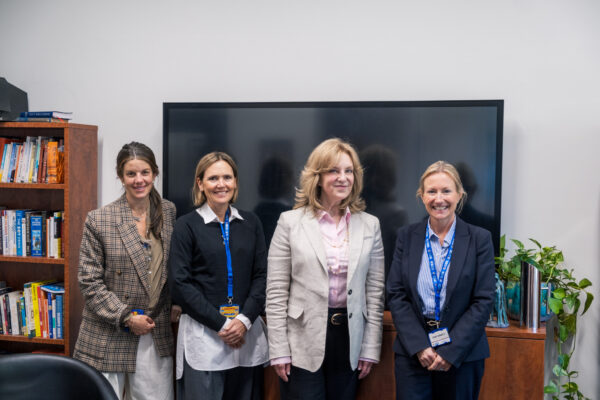
Deputy Headmaster, Head of the Crowther CentreWe were thrilled to host Sandra Boyes from the Crescent School in Toronto, Canada, when she visited BGS this week. We love having the opportunity to share research and reflect on what is working well (and what isn’t) with other schools for boys.
The Crescent School shares similar values to Brighton Grammar, with a focus on building men of good character. We had a great discussion about how this shows up day to day in school life. We both reflected that for boys and young men to thrive in today’s world, they need to learn and practise specific skills.
At Brighton Grammar, through the three pillars of our Positive Masculinity approach, we do this by supporting our students to show up as their authentic selves, build strong relationships and connections, and work towards achieving their goals. We discussed with Sandy how we achieve this – through formal instruction, along with modelling healthy approaches to masculinity.
We know boys and young men today face different challenges than we did as kids. By engaging with research, sharing learnings and strategies with our colleagues across the globe doing similar work, and using a strengths-based approach, we can help our boys to feel great about being a boy, while hopefully avoiding some of the common health challenges associated with masculinity.
Meeting with Sandy was a terrific opportunity to share what is working well here at Brighton Grammar, hear what works well at Crescent, and collaborate with leading researchers and practitioners.
Kristen Molloy, Ingrid Howren and Chloe Lorback
Crowther Centre
Preparing for Tests and Examinations
As we approach the end of the semester, many students are preparing for semester tests and examinations. One purpose of these assessments is to give students, parents and teachers a clear picture of what a student knows and can do.
An additional benefit is that the process of revising for tests and examinations helps students to embed their knowledge in long-term memory. Given that knowledge is what we think with, having knowledge stored in long-term memory is extremely helpful for subsequent learning and thinking.
A key method for revision is retrieval practice, the process of forcing yourself to recall knowledge without referring to notes or other guides. For example, if you are trying to commit capital cities to memory it can be helpful to test yourself with questions like “What is the capital of France?” or “What is the capital of Eritrea?” The act of successfully retrieving information strengthens long-term memory, which is what makes this such an effective revision strategy.

Many students have found cue cards to be a useful tool for revision. To experience the benefits of cue cards, it is important that students first try to retrieve the answer before flipping the card. If you see the card ‘Country: Eritrea’ on one side and then flip start to the other side to see ‘City: Asmara’, you have not actually retrieved anything, and this alone is unlikely to help embed this into your long-term memory. If, on the other hand, you write down the country ‘Eritrea’ on a piece of paper now, and then in five minutes try to remember its capital city, you will be doing genuine retrieval practice.
One final point about cue cards is that students can sometimes think that ‘doing cue cards’ involves constructing hundreds of cards, dutifully copying out pages of their notes. In fact, it is the act of testing yourself (or having someone else test you) on the contents of those cue cards which is of most benefit in strengthening long-term memory for tests and examinations.
Bryn Humberstone
Associate Head of the Crowther Centre
Director of Teaching and Learning ELC-VCE